Type locality: West side of Matupi Island, Simpson Harbour, Rabaul, New Britain, Territory of Papua and New Guinea; in pumice bank, 10 feet (3 mt) above sea-level.
Known distribution: Central Philippines, few findings in Malaysia and North Sulawesi. One specimen has been reported from the Solomon Islands by 1999.
Original description
Mühlhäusser H. (1981). “Strombus kleckhamae boholensis n. subsp (Gastropoda, Strombidae)“. Spixiana. 4(3): 319-324.
Name etymology: from the Bohol Island, South of Cebu, Central Philippines.
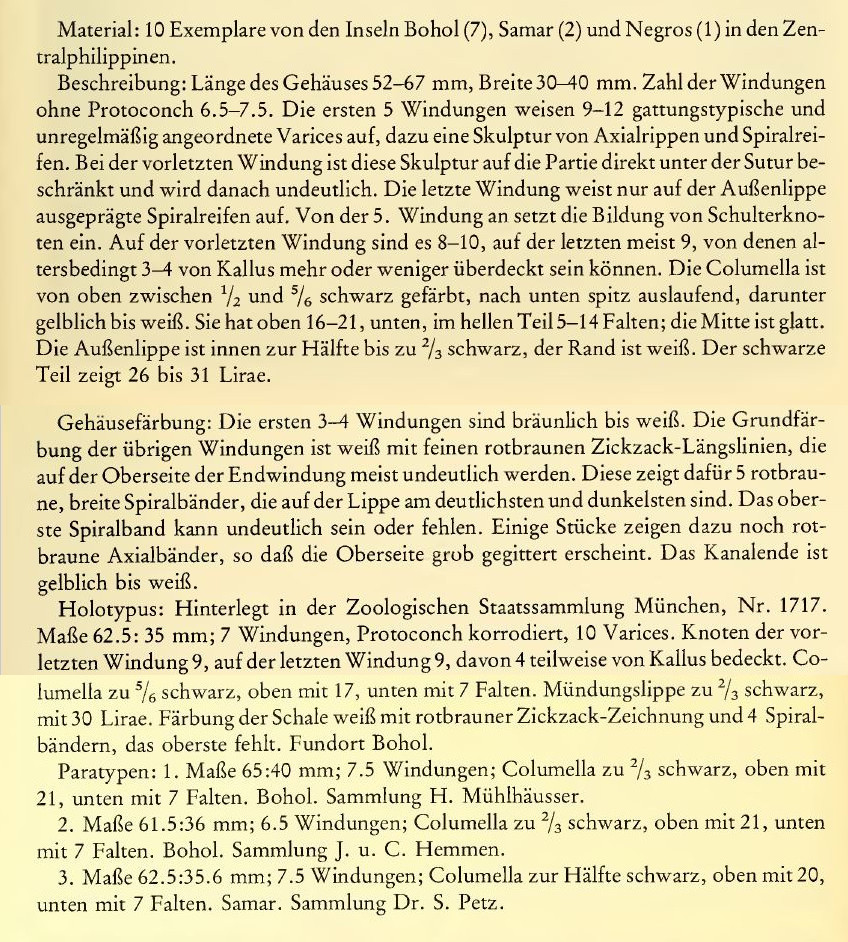
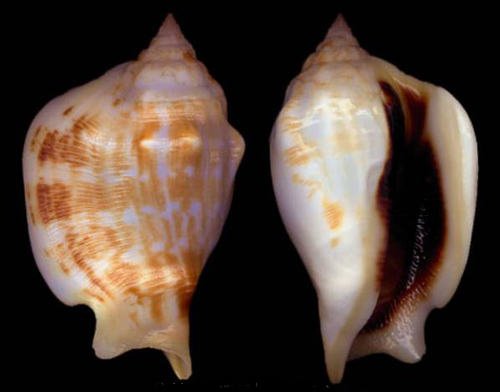
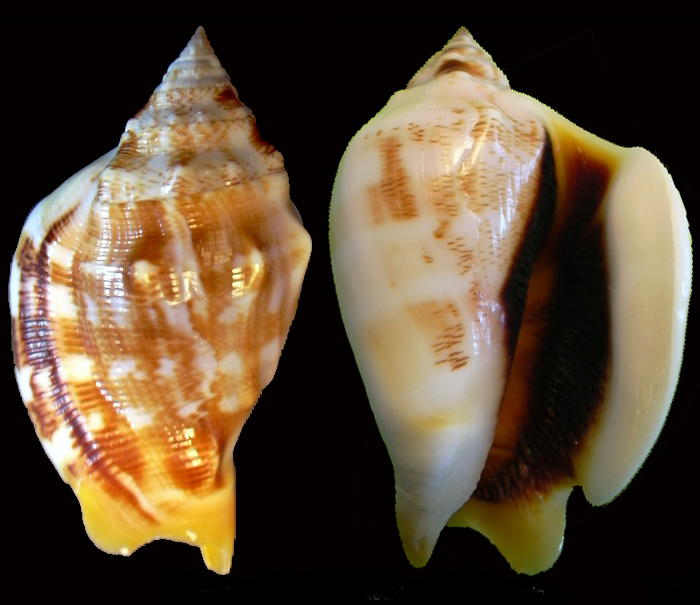
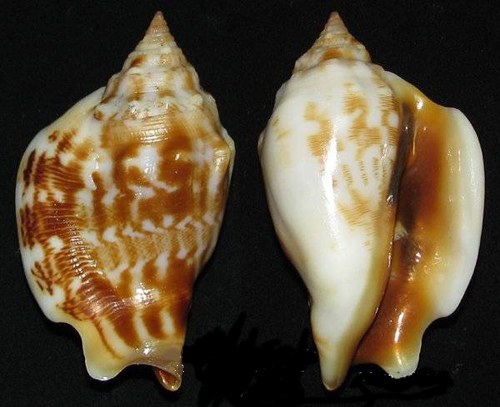
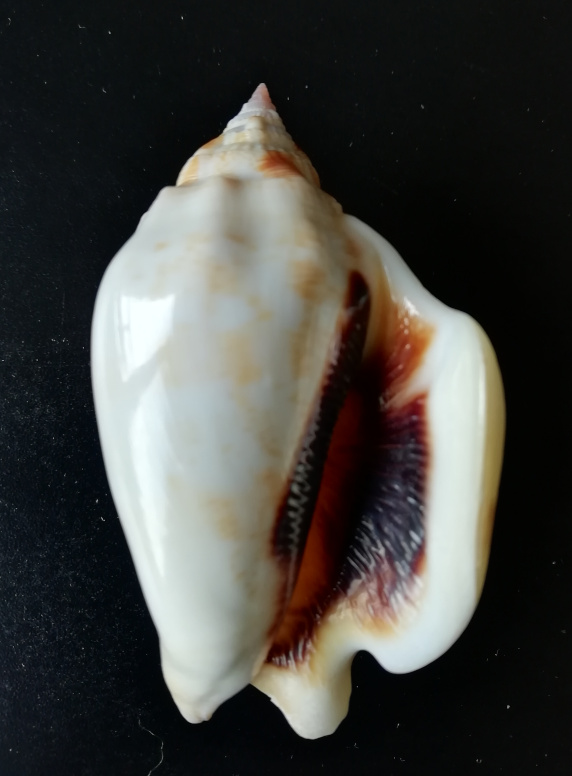
Material: 10 specimens from the islands of Bohol (7), Samar (2) and Negros (1) in the central Philippines. Description: Shell length 52-67 mm, width 30-40 mm. Number of whorls without protoconch 6.5-7.5. The first 5 whorls show 9-12 species-typical irregularly arranged varices, plus a sculpture of axial ribs and spiral hoops. In the penultimate whorl, this sculpture is confined to the portion just below the suture, and thereafter becomes indistinct. The last whorl has pronounced spiral hoops only on the outer lip. From the 5th whorl onwards, the formation of shoulder knots begins. On the penultimate whorl there are 8-10, on the last usually 9, of which 3-4 may be more or less covered by callus depending on age. The columella is colored black from above between 1/2 and 5/6, tapering downwards, yellowish to white underneath. It has 16-21 folds above, below, in the light part, 5-14 folds; the middle is smooth. The outer lip is up to 2/3 black on the inside, the edge is white. The black part shows 26 to 31 lirae. Shell colouration: The first 3-4 whorls are brownish to white. The basic color of the remaining whorls is white with fine reddish-brown longitudinal zigzag lines, which are mostly indistinct on the upper side of the terminal whorl. This shows 5 red-brown, wide spiral bands, which are most obvious and darkest on the lip. The uppermost spiral band may be indistinct or absent. Some specimens also show reddish-brown axial bands, so that the upper side appears gridded. The end of the canal is yellowish to white. Holotype: Deposited in the Munich State Zoological Collection, No. 1717. Measures 62.5: 35 mm; 7 whorls, protoconch corroded, 10 varices. Nodes of the penultimate whorl 9, on the last whorl 9, 4 of which are partially covered by callus. Columella 5/6 black, with 17 folds above and 7 below. Mouth lip 2/3 black, with 30 lirae. Shell colored white with reddish-brown zigzag markings and 4 spiral bands, the top one is missing. Locality Bohol. Paratypes: 1. Measures 65:40; 7.5 whorls; Columella 2/3 black, open with 21 folds, below with 7 folds. Bohol. Collection H. Mühlhausser. 2. Measures 61.5:36mm; 6.5 whorls; Columella 2/3 black, with 21 folds above and 7 below. Bohol. Collection of J. and C. Hemmen. 3. Measures 61.5:35.6 mm; 7.5 whorls; Columella half black, above with 20 folds, below with 7 folds. Samar. collection dr S Petz.
Description
Linnaeus, Carolus, 1758, Systema Naturae per regna tria naturae: secundum classes, ordines, genera, species, cum characteribus, differentiis, synonymis, locis, Stockholm
Notes
as Barneystrombus kleckhamae Cernohosky 1971, Barneystrombus boholensis Mühlhaüsser, 1981 is also living, differently by most of Strombidae species, in deep water, from 40 to 180 mt, so colelcted by divers and by dredging.
The type locality is Central Philippines, but it’s now clear that the area of distribution is much broader, to Malaysia and North Sulawesi (Indonesia). A record is also reported from Solomons Islands.
Lynton Stephens reported in Malacological Society of Australasia Newsletter No. 135 (March 2009) that he got a specimens of Barneystrombus boholensis Mühlhaüsser, 1981 personally colllected during diving at 40 mt deep by Roy Moyla, NW off Simuruka Island, Marau Sound, Guadalcanal, Solomon Islands. From the picture there’s no doubt that it is Barneystrombus boholensis Mühlhaüsser, 1981 and not Barneystrombus kleckhamae Cernohosky 1971. In addition it was also a specimen of 74.4 mm lenght, so quite big considering that the bigger specimen lenght collected in the Central Philippines of 78 mm and average size is 56 mm. This means that we’ll most probably seen other specimens in the future dredged in a much broader than the today supposed distribution area.
Personal collection
File writtenMCC0245, Barneystrombus boholensis, 67.6 mm, Pamilacan Island, Bohol, Philippines, 1999. by Adobe Photoshop? 5.0
MCC0254, 55 mm, Philippines, 2003.
MCC0255, 51 mm, in bottom nets on sandy bottom, 40-50 mt, Balicasag Island, Bohol, Philippines, 2008.
File writteMCC0256, Barneystrombus boholensis, 70 mm, Aliguay Island, Philippines, 2008.n by Adobe Photoshop? 5.0
MCC0747, Barneystrombus boholensis, 65 mm, dived on sandy bottom among coral blocks at 10-15 mt, Panglao, Bohol, Philippines, July 2007.
Cernohorsky W.O. (1971), “New molluscan species of Strombus (Strombidae) and Cancilla (Mitridae) from New Britain and Taiwan”, Records of the Auckland Institute and Museum. 15: 131-135.
Mühlhäusser H. (1981). “Strombus kleckhamae boholensis n. subsp (Gastropoda, Strombidae)“. Spixiana. 4(3): 319-324.
Mühlhäusser H. (1982). “Strombus kleckhamae boholensis n. subsp (Gastropoda, Strombidae)“. La Conchiglia – The Shell, Year XIV, 156-157, March-April, pag.9.
Richards A. (1984), “Differences in Strombus kleckhamae”, Hawaiian Shell News, Vol. XXXII, No. 3, New Series No. 291, pag. 13, March issue.
Mühlhäusser H. (1984), “Concerning Strombus kleckhamae”, Hawaiian Shell News, Vol. XXXII, No. 5, New Series No. 293, pag. 12, May issue.
Lynton S. (2009), “A report of Dolomena boholoensis (Mühlhaüsser, 1981) from the Solomon Islands”, Malacological Society of Australasia Newsletter, No. 135, March, pag. 7