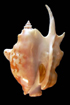
The superfamily Stromboidea


Habitat and Evolution
The Strombidae family (common name true conchs) is composed by more than 100 species subdivided in 30 genera distributed in all the worldwide tropical and subtropical seas, with a temperature above 20 Celsius degrees, corresponding to ± 30 degrees of latitude.
All the Strombidae species are herbivorous, feeding on algae and detritus. Most of them are shallow waters (1-5 mt), but few species can also be found in deep waters from tens to 200 mt (T.lorenzi, B.kleckhamae).
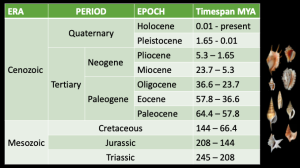
Based on paleontological studies, there’s evidence today that the Aporrhaiidae family was already existing in the Jurassic period, then evolving in the first species of the Rostellariidae family during the Creataceous (Liverani, 2013) and then into species of the Seraphsidae family during the Eocene epoch. The first Strombidae species appears in the Eocene as well and then this family flourished until the Pliocene in all the warm seas of the world (Abbott, 1960). In fact the Strombidae family seems to have replaced the Aporrhaidae family, today still existing with only 6 living species Vs. 50+ known fossil species (Roy, 1996).
Distribution
For convenience, the distribution areas of the Strombidae family are divided into the 5 malacological provinces: Indian (1), Pacifica (2), Panamanian (3), Caribbean (4) and Senegalensis (5).
Most of the species of Strombidae are found in the Indo-Pacific area; in fact only 7 species are found in the Caribbean province, 4 in the Panamanian province and only one (T. latus) in the Senegalesis province.
Over the last few decades a species has adapted to the Mediterranean environment: the C. persicus, native to the Persian Gulf and the southern Arabian coasts. A first survey took place in 1978 on the coasts of Turkey (Nicolay, 1986). This was followed by others throughout the eastern Mediterranean area (Israel, Lebanon, Greece, Rhodes, Cyprus). At the moment the accidental introduction of the species into the Mediterranean from ships through the Suez Canal is assumed to be plausible (Lessepsian migration).
Some species are endemic to some specific geographical areas of a malacological province, in some case in very restricted spots (L. pilsbry of the Marquesas Islands), others are wide spread across the two Indian and Pacific malacological provinces from East Africa to the Solomon Islands (L.lentiginosus, L.pipus, L.lambis, L.crocata, C.erythrinus, C,mutabilis, T.dentatus, E.aurisdianae). In few specific cases a species can be distributed in a vast area, but always restricted in very specific locality spots (T.thersites from Japan to Polynesia). Some species clearly share a common recent ancestor such as C.olydium in the Indian province and C.labiatum in the Pacific province, or T.afrobellatus and T.terebellatus in the same provinces. Another example is the S.pugilis and the S.gracilior in the Caribbean and Panamian provinces.


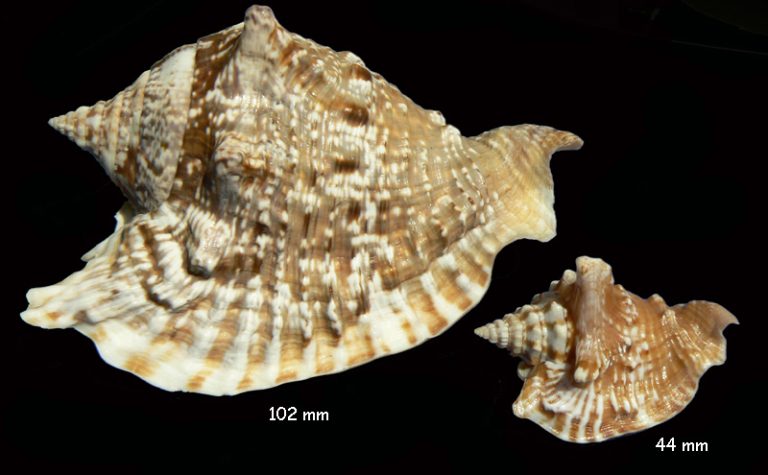

Sinustrombus sinuatus x taurus; hybrid form; copyright Strombidae.de, Photo Bob Abela; Coll. Fred Schroede
Size and Morphology
SIZE: the size of the Strombidae family adult specimens vary from 10 mm of some genus Canarium species to the 380 mm of the Titanostrombus goliath and the 400 mm of the Lambis truncata.
JUVENILE: shell specimens that have not reached the adult form yer are called juvenile. In Strombidae shells the juvenile specimens are easily recognized by incomplete number of whorls and the thinness of the outer lip, normally thick in adult specimens. Specimens close to the adult form (complete number of whorls but still thin outer lip) are also called subadult. Another characteristic of Strombidae gerontic specimen is a yellow or alluminium-like glaze on the edge of the outer lip or the columellar callus that in some cases have been confused with specific forms (T.insulaechorab f. luteostoma).
DIMORPHISMS: the size of some Strombidae family species varies between female and male specimens, with the latter beig smaller. I some cases such difference in size originated the erroneous description of new species or forms.
DWARFIRMS: some Strombidae species can show in their range of distribution isolated populations with smaller average size, classified with forms such as dwarf, nanus, nana, etc. but still classified in the same species.
HYBRIDISM: a biological species has been classified defined as the largest group of organisms in which any two individuals of the appropriate sexes or mating types can produce fertile offspring, typically by sexual reproduction. Ernst Mayr has also observed that some different species could in theory be able to produce a species (hybrid) with intermediate morphological characteristics but this is not happening due to obstacles existing in nature (such as different geographical distribution, different period for mating, etc.). Hybridism is existing in nature between different Strombidae family species with quite regular occurrences withing the genus Lambis (Lambis crocata x scorpius) and more rarely in other genera (ex. Sinustrombus sinuatus x taurus) or even between different genera (Lambis lambis x Sinustrombus latissimus).
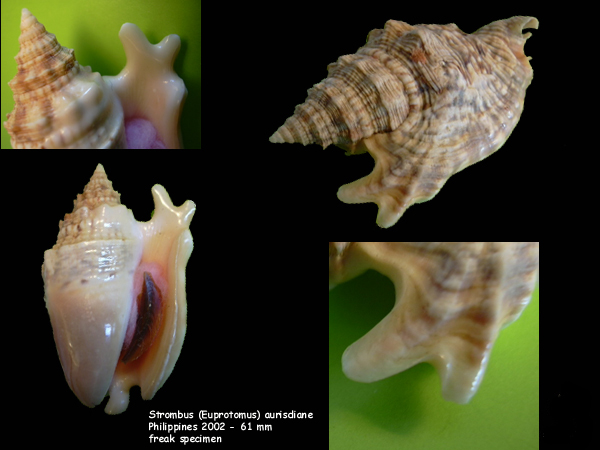
FREAKISM: freak shells are shell specimens with unusual morphology deviating from the typical shells of such species population. Freakism can be induced to particular specimens by illnesses occurring during the growth of the shell or other mechanical causes which could have influenced an abnormal development of the shell, such as crushing due to rocks or fish bites.
Characteristics
All species of the Strombidae family share a series of characteristics:
- they are vegetariansor detritus-feeder
- they have two tentacles at the end of which they present the two eyes in the center of the ocular tentacles
- they have a proboscis, at the end of which is the mouth
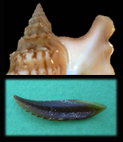
- radula taeniglossa composed of lines of 7 teeth forming 2 + 1 + R + 1 + 2
- they are equipped under the foot with a cartilaginous operculum, a sort of sickle-shaped nail
- unlike common land snails they are able to move in jerks by making leaps (leaping motion)
- the shell of adult specimens has a flared lip on the external lip
- they show sexual dimorphism: in the same species the female specimens are on average larger than the male specimens
- the external lip, near the anterior siphon canal, presents the characteristic notch (stromboid notch, absent in the family Seraphsidae) from which the mollusk protrudes the right ocular tentacle. In this way the mollusk is able to check for potential dangers before reaching out from the shell


Euprotomus vomer, Komodo National Park, Indonesia. Copyright Steve Jones.

Conomurex luhuanus, Okinawa, copyright Shwan Miller.
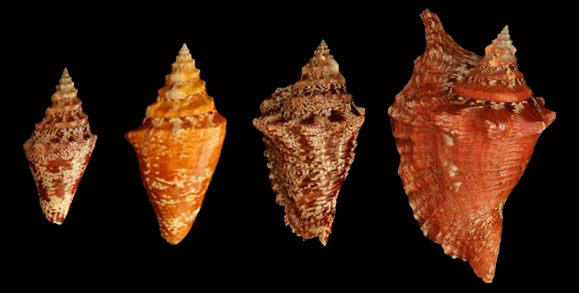
Strombus gallus growth
from juvenile to adult specimen
Anatomy
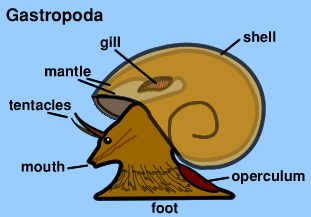
Like all gastropods, the conch is made up of a soft body (mollusk) with a spiral shape and a calcareous exoskeleton (shell), normally of the right-handed type, that is, with an opening located to the right of the axis of the shell if you look at it. from the ventral side and with apex facing upwards.
The mollusc consists of a foot that favors locomotion, the head, the pouch of the viscera and the mantle, which presides over the formation of the shell. The mollusk never separates from the shell, but can stretch out its foot or its head. When threatened it can burrow inside the shell using the operculum as a door to close itself inside or as a defense weapon thanks to its sickle shape.
As mentioned, the head is constituted in the center by a retractable proboscis, at the end of which there is the mouth and which the mollusk can reach out to look for food, and by two tentacles at the end of which there are the eyes bordered in orange (Kronenberg&Berkhout, 1981). When the animal is in extension it is possible to recognize the sex of the animal in proximity of the right tentacle, a black peduncle (penis) in the case of the male, a groove in which to contain the eggs in the case of the female.
Above the foot and around the shell, the mollusk presents the mantle, which has the task of building the shell and keeping it clean and shiny. In fact, the shell is not made up of living tissue, but essentially made up of calcium carbonate (like our bones) for at least ninety percent. It is the mantle that produces the substance from which the shell originates, absorbing calcium from the surrounding environment and transferring it to the mantle and aggregating everything with a texture of conchiolin, an organic substance. The shell consists of three layers. From the outside we have the periostracum, of organic substance, which has the task of protecting the shell, then we have respectively the ostraco and the hypostracum, which constitutes the innermost layer in contact with the mantle.
Development of the mollusk:
To understand how the shell is formed we think of the analogy of a man who builds a circular wall around himself in the shape of a spiral, and as he proceeds with the outer walls he builds it higher and higher. often. In our analogy the man is the mollusk, which is basically constituted by a soft tube that increases its size going from the inside towards the opening of the shell, which has a spiral shape and which as it grows continues to build a shell around himself. In the event that a part is damaged, the mollusk, through the particular substance secreted by the mantle, carries out the repair. As the mollusk grows, and at regular intervals, this creates wider spaces which are the nodules and thorns on the back of the animal, which have the task of giving stability to the shell and not letting it roll in case of sea currents.
Upon reaching sexual maturity, the behavior of the mollusk changes radically. In fact this stops growing in terms of length and size and begins to form a wing-shaped outer lip. From this moment on, the material secreted by the mantle continues to accumulate on the outer lip of the shell, thus continuously increasing in thickness. For this reason, juvenile specimens usually have a light shell and a thin outer lip and the adult ones a heavier shell and thickened outer lip.
Radula
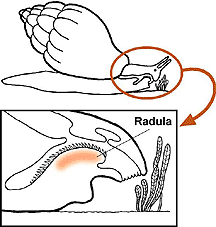
The radula is the set of teeth that the mollusk has inside the mouth and that it uses to scrape food such as algae from a rocky substrate. The radula is located on a cartilage base called odontophore. Through a series of muscles the mollusc can move the odontophore (1) and above this the series of teeth that make up the radula (2). Through a muscle the mollusk makes the odontophore come out and it comes into contact with food, then the movement of the radula allows it to tear pieces of food and convey them into the esophagus. Depending on how the teeth are organized in the radula it is possible to classify 7 different types of radula. The radula is an important element in the classification of gastropod molluscs as it is possible to group them according to the type of radula. The type of radula allows to identify the type of feeding of the mollusk, from an exclusively herbivorous one, typical of the more archaic species to a carnivorous one, typical of the more evolved species towards predatory behavior. All gastropods of the order Caenogastropoda have radula taenioglossa. All the Strombidae family species have taenioglossal radula with seven teeth per row.

Behaviour
MORPHOLOGY
FEEDING
REPRODUCTION
MOTION
DEFENSE
Fishery
Conchs are an important marine resource in the Caribbean, where the Queen conch (Aliger gigas) is particularly well known. Queen conch fishery production was 15.487 tons in 1999. Since the end of 1970′ the depletion of the population of the Queen conch accelerated due to the export to the US, causing specific protection for this species regulated by CITES and the development of aquaculture.
S.pugilis has been mentioned (Fluck, 1905) as an important source of food for the natives in Nicaragua.
Other species of the Strombidae family are regularly used as food in the Indo-Pacific region, such as L.lambis, L.Canarium, C.urceus.


